How to Play Poker: Everything Beginners Need to Know
Poker is one of the world’s most popular card games, enjoyed in casinos, online poker rooms, and friendly home games. Unlike many casino games that rely primarily on chance, Poker combines skill, strategy, probability, and decision-making. While luck influences the cards you receive in any individual hand, experienced players use knowledge and discipline to make better decisions over time.
For beginners, Poker may seem intimidating because of its betting rounds and hand rankings. However, once you understand the basic rules, the game becomes much easier to follow. Today, most online casinos and poker platforms offer beginner-friendly tables, tutorials, and free-play games that make learning Poker more accessible than ever.
This complete guide explains how to play Poker, including the rules, hand rankings, betting rounds, table positions, and practical tips to help you build confidence before playing for real money.
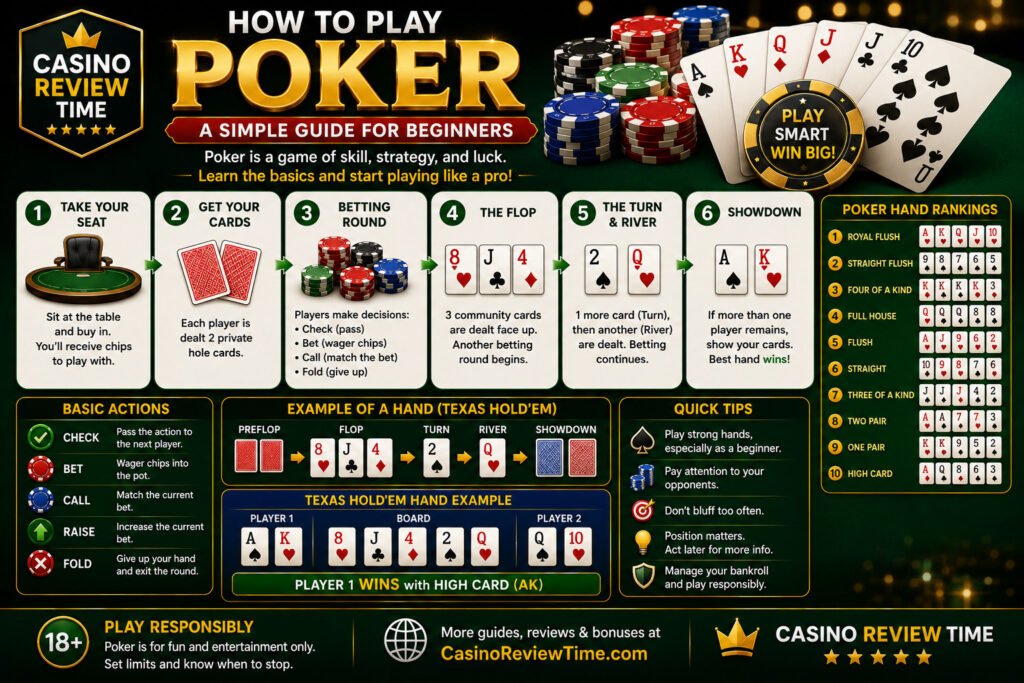
Table of Contents
What Is Poker?
Poker is a card game in which players compete to win a pot by:
- Making the strongest five-card hand according to Poker hand rankings, or
- Convincing all other players to fold before the showdown.
Unlike Baccarat or Roulette, Poker often involves competing against other players instead of the casino. Some casino-based variants, such as Caribbean Stud Poker and Three Card Poker, are played against the dealer, but the basic concepts of hand rankings still apply.
The most widely played version worldwide is Texas Hold’em, making it an excellent starting point for beginners.
Understanding Poker Hand Rankings
Before learning how to play, you must understand how Poker hands are ranked.
Royal Flush
The highest possible Poker hand.
Example:
A♠ K♠ Q♠ J♠ 10♠
Straight Flush
Five consecutive cards of the same suit.
Four of a Kind
Four cards with the same rank.
Full House
Three cards of one rank and two cards of another rank.
Flush
Five cards of the same suit, not in sequence.
Straight
Five consecutive cards of different suits.
Three of a Kind
Three cards with the same rank.
Two Pair
Two different pairs.
One Pair
Two cards of the same rank.
High Card
If no player has a stronger combination, the highest individual card determines the winner.
Learning these rankings is essential because every winning Poker hand is determined using this hierarchy.
Basic Poker Rules
Although Poker has many variations, the core rules remain similar.
Players receive cards, participate in one or more betting rounds, and compare hands at the showdown if more than one player remains.
During a betting round, players may:
- Check
- Bet
- Call
- Raise
- Fold
The goal is either to hold the best hand at the showdown or win the pot by causing every other player to fold.
How to Play Texas Hold’em
Texas Hold’em is the most popular Poker variation and the easiest place for beginners to start.
Each player receives:
- Two private cards (hole cards)
- Five shared community cards placed face up on the table
Players use any combination of these cards to make the best possible five-card hand.
Step-by-Step: How to Play Poker
Step 1: The Blinds
Before cards are dealt, two forced bets are placed:
- Small Blind
- Big Blind
These bets create the starting pot and ensure there is always something to play for.
Step 2: Deal the Hole Cards
Each player receives two private cards that only they can see.
Step 3: First Betting Round (Pre-Flop)
Players decide whether to:
- Fold
- Call
- Raise
based on the strength of their starting hand.
Step 4: The Flop
Three community cards are revealed.
Players now combine these cards with their hole cards to improve their hand.
A second betting round follows.
Step 5: The Turn
A fourth community card is dealt.
Another betting round takes place.
Step 6: The River
The fifth and final community card is revealed.
Players participate in the final betting round.
Step 7: The Showdown
If two or more players remain after the final betting round, they reveal their cards.
The strongest Poker hand wins the pot.
Common Poker Actions
Check
Pass the action without betting when no wager has been made.
Bet
Place the first wager during a betting round.
Call
Match the current bet made by another player.
Raise
Increase the current bet.
Fold
Discard your cards and forfeit the current hand.
Understanding Table Position
Position is an important concept in Poker.
Players who act later in a betting round have more information because they can observe previous actions before making their own decisions.
Common positions include:
- Early Position
- Middle Position
- Late Position
- Dealer Button
Many experienced players consider late position advantageous because it provides more information before acting.
Popular Poker Variations
Modern online casinos offer many Poker games.
Texas Hold’em
The most popular version worldwide.
Omaha Poker
Players receive four private cards but must use exactly two of them.
Seven-Card Stud
Players receive individual cards without community cards.
Caribbean Stud Poker
Played against the dealer rather than other players.
Three Card Poker
A fast-paced casino game using three-card hands.
Online Poker vs Live Poker
| Online Poker | Live Poker |
|---|---|
| Faster gameplay | Slower pace |
| Play from anywhere | Casino or poker room |
| Multiple tables | Face-to-face interaction |
| Mobile compatible | Physical chips and cards |
| Beginner-friendly stakes | Traditional atmosphere |
Both formats follow the same basic rules.
Beginner Tips
Although Poker combines luck and skill, these practical tips can help you improve.
Learn Hand Rankings
Knowing winning hands is essential.
Play Fewer Hands
Many beginners play too many weak starting hands.
Being selective often leads to better decision-making.
Practice With Free Games
Many online platforms allow players to learn without risking real money.
Pay Attention
Observe betting patterns and player behavior.
Manage Your Bankroll
Set realistic spending limits before every session.
Common Beginner Mistakes
Many new players:
- Play too many hands.
- Ignore table position.
- Bluff too often.
- Chase unlikely draws.
- Gamble emotionally after losing.
Avoiding these mistakes can improve long-term performance.
Is Poker Based on Skill or Luck?
Poker combines both skill and chance.
Luck influences:
- Card distribution
- Short-term results
Skill influences:
- Decision-making
- Probability calculations
- Reading opponents
- Position awareness
- Bankroll management
While no strategy guarantees success, improving these skills can help players make more informed decisions over time.
Responsible Gambling
Poker should always remain a form of entertainment.
Responsible players should:
- Set spending limits.
- Never chase losses.
- Take regular breaks.
- Gamble only with money they can afford to lose.
- Stop playing if the activity is no longer enjoyable.
Responsible gambling helps maintain a positive gaming experience.
Before you play, it’s important to understand both the benefits and the risks.
- Bigger thrills – Real cash prizes raise the stakes
- Life-changing wins – Jackpots can turn lucky spins into fortunes
- More game variety – Access the full selection of high-quality casino games
- Lucrative bonuses – Claim deposit matches, free spins, and cashback offers
- VIP rewards – Loyalty programs give frequent players extra perks
- Risk of loss – You’re playing with your own money
- Requires Responsible Play – Players should set budgets and gamble responsibly to maintain a positive experience.
How to Get Started
1️⃣ Sign Up – Create an account in minutes.
2️⃣ Deposit – Choose from multiple secure payment options.
3️⃣ Place Your Bets – Pick your favorite sports and events.
4️⃣ Win Big! – Cash out your winnings instantly.
Join Now & Claim Your Bonus!

Get up to:
288% Bonus
Up to $150
Daily Unlimited Reload Bonus
+ NBA FREE Bets

Get up to:
100% Bonus
Up to $1000
* New Players only.

Get up to: 100% Bonus * New Players only.

Get up to:
100 Free Spins
1 for every $10 deposit
1 Free Spin credited for every $10 deposit. Up to 65 Free Spins valued at $0.15 each on Book.

Get up to:
Up to $400
First deposit – 180% Up to $400 + Free Spins

Wellcome Offer:
$10
Bonus for New Players
SPIN & WIN Rewards up to $10,000. T&Cs apply.
Frequently Asked Questions
Is Poker difficult to learn?
No. The basic rules are straightforward, although becoming a skilled player requires practice and experience.
Which Poker game should beginners play?
Texas Hold’em is widely recommended because of its simple rules and widespread availability.
Can I play Poker on my phone?
Yes. Most licensed online casinos and poker platforms support Android and iOS devices.
Is Poker based entirely on luck?
No. While luck affects individual hands, skill plays an important role in long-term decision-making.
Can I play Poker for real money?
Yes. Licensed online casinos and poker rooms offer real-money games where permitted by local laws.
Final Thoughts
Learning how to play Poker is the first step toward enjoying one of the world’s most strategic and rewarding card games. By understanding hand rankings, betting rounds, table positions, and basic decision-making, beginners can quickly develop the confidence needed to participate in both online and live games. How to Play Poker.
Whether you choose Texas Hold’em, Omaha, Seven-Card Stud, or a casino Poker variant, always play at licensed and reputable platforms that provide fair games, secure payment methods, and responsible gambling tools. Practice with free games whenever possible, build your skills gradually, and remember that Poker rewards patience, discipline, and informed decision-making over time.
Related Articles
- How Sportsbook Welcome Bonuses Work
- How Sportsbook Free Bets Work
- How Casino Free Spins Work
- Casino No Deposit Bonus Explained
- Casino Welcome Bonus Explained
#how to play poker #poker rules #poker guide