Poker Strategy: Learn the Fundamentals of Smarter Poker Play
Poker is one of the few casino-related card games where player decisions can significantly influence long-term results. While luck determines the cards dealt in each hand, successful Poker players rely on strategy, discipline, probability, and sound decision-making to improve their performance over time.
Unlike games such as Roulette or Baccarat, where outcomes are determined almost entirely by chance, Poker requires players to make continuous decisions throughout every hand. Choosing when to bet, call, raise, fold, or bluff can greatly affect the outcome of a session.
It is important to understand that no Poker strategy guarantees consistent winnings or eliminates the role of chance. Every hand is unique, and even the strongest players experience losing sessions. The goal of a good strategy is to make better decisions over many hands rather than trying to win every individual game.
This guide explains the core principles of Poker strategy, including starting hand selection, table position, bankroll management, bluffing, and common mistakes to avoid.

Table of Contents
What Is Poker Strategy?
Poker strategy is the process of making informed decisions based on:
- Hand strength
- Table position
- Opponent behavior
- Pot size
- Betting patterns
- Probability
- Bankroll management
Rather than relying on luck alone, strategic players aim to maximize value when they have strong hands and minimize losses when they do not.
Although every Poker variation has unique rules, these strategic concepts apply broadly to games such as Texas Hold’em, Omaha, and Seven-Card Stud.
Learn the Rules Before Learning Strategy
Before developing any strategy, make sure you understand the basics of Poker.
You should know:
- Poker hand rankings
- Betting rounds
- Blinds
- Community cards
- Showdowns
- Table positions
A solid understanding of the rules provides the foundation for better decision-making.
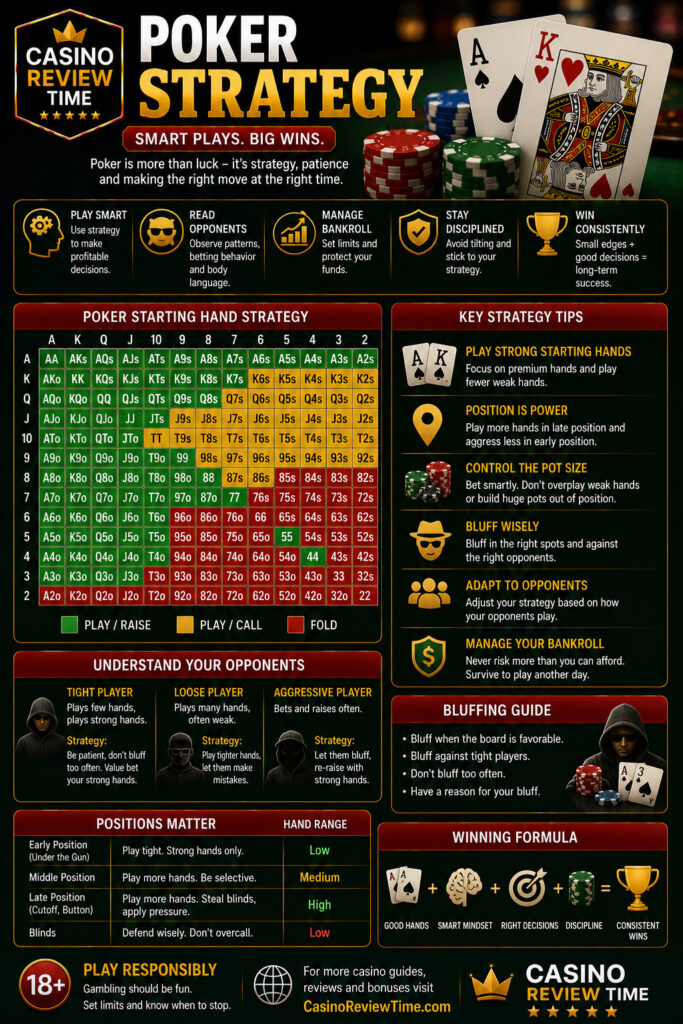
Starting Hand Selection
One of the biggest mistakes beginners make is playing too many hands.
Strong starting hands generally provide better opportunities than weaker combinations.
Instead of playing every hand, experienced players often become more selective and fold weaker starting hands when appropriate.
Being patient before entering the pot is an important part of long-term Poker strategy.
Understanding Table Position
Position is one of the most valuable concepts in Poker.
Players who act later during a betting round have more information because they can observe how opponents act first.
Common positions include:
- Early Position
- Middle Position
- Late Position
- Dealer Button
Late position often allows players to make more informed decisions because they have already seen the actions of other players.
Reading Opponents
Poker involves observing betting behavior as well as the cards.
Pay attention to:
- Betting sizes
- Frequency of raises
- Calling habits
- Folding tendencies
- Overall playing style
While online Poker provides fewer physical clues than live games, betting patterns can still offer valuable information.
Keep in mind that reads are never certain and should be used alongside sound decision-making.
Pot Odds and Probability
Successful Poker players often consider the relationship between:
- The size of the current pot
- The cost of calling
- The likelihood of improving their hand
This concept is commonly known as pot odds.
Understanding probability can help players evaluate whether continuing in a hand is mathematically reasonable under the circumstances.
Bluffing
Bluffing is one of Poker’s most famous strategies.
A bluff involves representing a stronger hand than you actually hold.
Effective bluffing depends on many factors, including:
- Table position
- Opponent tendencies
- Betting history
- Board texture
- Stack sizes
Bluffing does not guarantee success, and beginners often benefit from using it selectively rather than frequently.
Value Betting
Value betting means wagering with a strong hand in hopes that weaker hands will still call.
The goal is to maximize potential returns when you believe your hand is likely ahead.
Balancing value betting with careful observation of opponents is an important strategic skill.
Bankroll Management
Good Poker strategy includes managing your bankroll responsibly.
Helpful practices include:
- Set a gambling budget before playing.
- Choose games that fit your bankroll.
- Avoid risking a large portion of your bankroll in a single session.
- Accept that losing sessions are part of Poker.
- Avoid increasing stakes to recover losses.
Strong bankroll management helps players remain disciplined during both winning and losing streaks.
Online Poker vs Live Poker Strategy
While the basic principles remain similar, some strategic considerations differ.
Online Poker
Advantages:
- Faster gameplay
- More hands per hour
- Statistical tracking tools (where permitted)
- Convenient access
Players often rely more heavily on betting patterns because physical tells are limited.
Live Poker
Advantages:
- Face-to-face interaction
- Opportunity to observe physical behavior
- Slower pace
- Social atmosphere
Live Poker allows players to gather additional information through timing, speech, and general table behavior, although none of these observations guarantee accurate conclusions.
Common Beginner Mistakes
Many new players develop habits that reduce their chances of making good decisions.
Common mistakes include:
Playing Too Many Hands
Weak starting hands often lead to difficult situations.
Ignoring Position
Acting without considering table position can make decisions more challenging.
Bluffing Too Frequently
Frequent bluffing becomes predictable and may reduce effectiveness.
Chasing Draws Without Proper Odds
Continuing with unlikely drawing hands can become costly over time.
Playing Emotionally
Making decisions out of frustration or excitement often leads to poor judgment.
Poker Variations and Strategy Differences
Each Poker variation requires adjustments.
Texas Hold’em
Focuses heavily on:
- Position
- Starting hand selection
- Community cards
Omaha
Players receive four hole cards, creating more possible hand combinations and requiring different strategic considerations.
Seven-Card Stud
No community cards are used.
Memory and observation become increasingly important.
Caribbean Stud Poker
Played against the dealer rather than other players.
Strategy focuses primarily on understanding the game’s fixed rules and betting structure.
Is Poker Skill or Luck?
Poker combines both.
Luck determines:
- Which cards are dealt
- Short-term outcomes
Skill influences:
- Hand selection
- Betting decisions
- Bluffing
- Probability assessment
- Opponent observation
- Bankroll management
Although no strategy guarantees winning sessions, making consistently informed decisions can improve long-term performance compared with relying on guesswork.
Responsible Gambling
Poker should always be played responsibly.
Remember to:
- Gamble only with money you can afford to lose.
- Set spending and time limits.
- Never chase losses.
- Take regular breaks.
- Stop playing if gambling is no longer enjoyable.
Responsible gambling supports a healthier and more enjoyable gaming experience.
Frequently Asked Questions
Does Poker strategy guarantee winnings?
No. Strategy improves decision-making but cannot eliminate luck or guarantee profits.
Is Poker mostly skill?
Poker combines skill and chance. Over many hands, skillful decision-making generally plays a larger role than in many other casino games, but chance still affects individual outcomes.
Should beginners bluff often?
Most beginners benefit from using straightforward play while learning the game rather than relying heavily on bluffing.
Is bankroll management important?
Yes. Responsible bankroll management helps players reduce financial risk and maintain discipline.
Can I practice Poker strategy for free?
Yes. Many online poker platforms offer free-play or practice games that allow players to learn without risking real money.
Final Thoughts
Poker strategy is about making informed decisions rather than relying on luck alone. Understanding hand selection, table position, betting patterns, probability, and bankroll management can help players build a strong foundation for long-term improvement.
Whether you play Texas Hold’em, Omaha, Seven-Card Stud, or casino Poker variants, always choose licensed and reputable platforms that provide secure payment methods, fair gaming systems, and responsible gambling tools. Practice regularly, continue learning, and remember that successful Poker is built on patience, discipline, and sound decision-making—not guaranteed winning systems.